

A Gutter Only Works If the Rain Gets In
The pitch for gutter guards is simple: install them once and never climb a ladder again. But a gutter has one job, which is to catch the water coming off the roof and carry it away from the house. A guard is a cover placed over the opening, which means every drop of water now has to get past the cover before it can get into the gutter. That is the part the sales pitch leaves out.
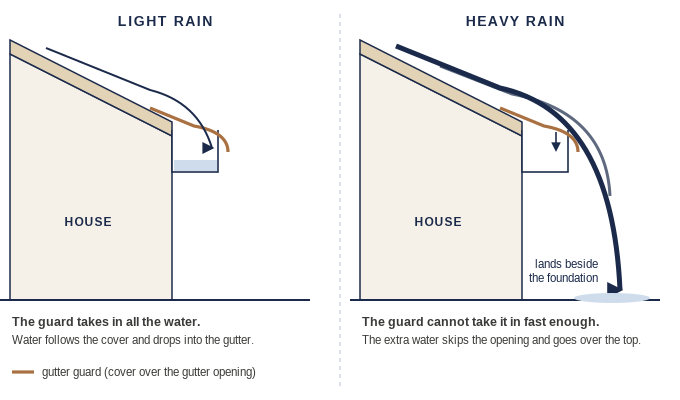
Whether the guard is a screen, a fine mesh, or a curved hood, it makes the opening smaller, and a smaller opening can only take in so much water at a time. Curved covers rely on water clinging to the curve and following it into a narrow slot. Mesh and screen covers rely on water passing through small holes. Both can keep up with a gentle rain. The trouble starts when the water arrives faster than the opening can take it.
What Happens in a Heavy Rain
An open gutter catches nearly everything, because there is nothing in the way. In a heavy rain, a roof sends a lot of water toward the edge quickly, and the faster it moves, the less willing it is to turn the corner and go into a slot or through a mesh. Instead it keeps going, skips over the top of the guard, and drops past the gutter entirely. The gutter underneath can be completely empty while the water that was supposed to go into it lands on the ground beside the house.
It tends to get worse where the roof delivers the most water: below a valley where two roof sections meet, at the bottom of a long or steep roof, and anywhere a downspout from an upper roof empties onto a lower one.
Where Guards Tend to Fall Short
- Heavy rain overflow. As described above, the water you most need the gutter to catch is the water most likely to skip it.
- Harder cleaning. When a guarded gutter does clog, you usually have to unscrew or lift the guard first. That is a bigger job than cleaning an open gutter.
- Fit and installation. Guards that sag, lift, or leave a gap at the roof edge let water out and debris in. Many of the products on the market fail because of the details of how they are installed, not the product itself.
Independent testing of these products has been mixed for years. Recent hands-on reviews tend to rank fine micro-mesh designs ahead of the curved, reverse-curve covers, which are the ones most likely to overflow in a downpour. Treat any ranking with some caution, since many review sites earn money from the products they rank.
Where They Can Make Sense
A guard is not useless. On a house surrounded by large, heavy-leaved trees, a well-installed fine mesh can cut the number of cleanings. On a hard-to-reach roofline where a ladder is a real hazard, it may be worth it. The mistake is treating a guard as a replacement for looking at the gutter. Expect to inspect guarded gutters at least once a year, and watch how they behave during the next heavy rain.
What the Gutter Is Really For
A gutter is not a decoration. Its job is to take the water that lands on your roof and put it somewhere away from the house. When it fails, that water ends up in the soil beside the foundation, and that is a much more expensive problem than a bucket of leaves. Wet soil pressing against a basement wall is the starting point for the kind of wall failure we describe in this article.
The simplest protection is usually the least exciting: keep the gutters open and flowing, make sure each downspout empties well away from the house, and check the whole system in the next heavy rain. If a guard helps you do that, good. If it keeps rain out of the gutter, it is working against you.