

A Floor Is Not a Fixed Thing
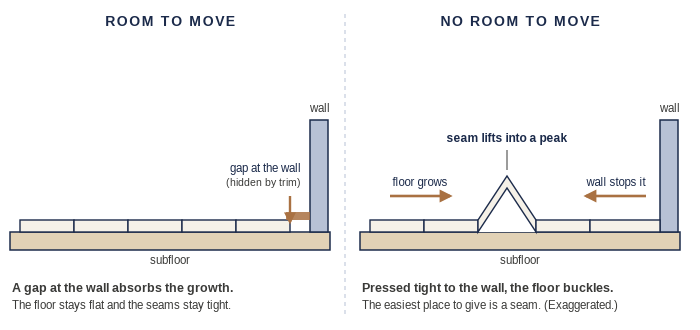
Most floors do not stay exactly the size they were on the day they were installed. Wood, laminate, and vinyl plank all expand and contract with changes in temperature and humidity. A well-installed floor is built to allow for that. A floor that buckles, with seams that lift into a peak or planks that stand up off the subfloor, is usually a floor that had nowhere to go.
This article is mostly about floating floors, the click-together laminate, luxury vinyl plank, and engineered wood that are laid over the subfloor without being fastened to it. Solid hardwood and tile have their own versions of the same problem, covered briefly below.
The Most Common Causes
- No expansion gap at the walls. Floating floors need a gap around the whole perimeter, usually somewhere around a quarter to a half inch. The manufacturer of the product being installed will provide guidance on exactly how big the gap should be for their specific product. The gap at the edge of the room is hidden under baseboard and trim. If the floor is tight to the wall, any expansion will cause the seams of the flooring to buckle.
- Something pinning the floor. A floating floor cannot be fastened or boxed in. Kitchen cabinets, an island, a fireplace hearth, a heavy built-in, or even trim nailed through the floor instead of into the wall will hold part of it in place while the rest moves.
- Long runs with no break. Manufacturers limit how far a floor can run without a transition or expansion joint. A floor laid straight through several rooms and a hallway can exceed that limit and collect all of its movement in one weak seam.
- Moisture from below. A concrete slab or a damp crawl space can send moisture up into the floor. Wood-based products swell, and the edges of a plank can push up as they absorb it. A floor installed over a slab without a moisture check is a gamble. Moisture from below especially on a concrete slab can also introduce a mold problem under the flooring over time.
- Heat from the sun. Vinyl in particular grows when it heats up. A floor in front of large south or west facing window can run much hotter than the rest of the room. The concentrated heat in that spot will cause the flooring in that area to swell significantly more than the surrounding area causing buckling at the seams of boards.
- An uneven subfloor. A high spot or a low spot makes a floor flex at the same place over and over, and a locking joint that flexes will eventually fail. Lifeproof, a reputable LVP manufacturer that we like using, requires the floor to be level within 1/8" over a 6 foot span or 3/16" over a 10 foot span for the warranty of the product to be valid.
Solid Hardwood and Tile
Solid hardwood reacts to humidity above all. Boards installed too wet or before they have adjusted to the house will gap in the dry season and may cup or buckle in a humid one, especially after a leak or a flood.
Tile has its own version of the problem. Tile is rigid, and the slab or subfloor under it is not. It shrinks, shifts, and cracks with the seasons, and if the tile is glued directly to it, the tile has to move with the subfloor. When it cannot, the tile cracks or tiles can be popped off of the floor in some circumstances. The TCNA (Tile Council of North America) Handbook does allow for tile to be installed over plywood but there are certain conditions that need to be met to meet the TCNA standards for tile over plywood.
Most commonly the solution is the use of an uncoupling membrane. It is a thin sheet, usually with a grid of small cavities and a fabric backing, that is bonded to the subfloor with thin-set mortar, with the tile set on top of it. Because the tile is no longer bonded straight to the substrate, the membrane absorbs the small sideways movement underneath instead of passing it up into the tile. Uncoupling membrane only relieves stress along the horizontal plane. The expansion and contraction of the subfloor can be absorbed by the uncoupling membrane. Uncoupling membrane does not help relieve the stresses of deflection of the subfloor. If your subfloor has deflection issues those need to be addressed before an uncoupling membrane or tile is installed if you want a quality tile installation.
What to Look For and What Fixes It
If seams are peaking, first look at the edges. Pop the baseboard or shoe molding in a corner and see whether the floor touches the wall. Look for anything that is rigidly holding the floor, like a cabinet base sitting on top of it. Check whether the buckle follows a line of sunlight, a leaking pipe, or a doorway.
In many cases the fix is to trim the floor back from the wall to restore the gap. A transition at a doorway may help reduce pressure in long runs of flooring. If moisture is the cause, it has to be found and stopped first, or the new floor will do the same thing. Where a floor has been soaked often the best solution is to remove and replace the flooring to ensure that mold does not begin growing underneath it.
In conclusion
Many buckled floors are not a sign of a bad product. They are a sign that the floor was never given room to move, or that something underneath it was not right to begin with. The best fix is the one that happens before the first plank goes down: a flat, dry subfloor that meets the manufacturer's requirements, a moisture check on any slab, a proper gap at every wall and fixed object, and a layout that breaks up long runs. Under tile, the same thinking applies. Fix any deflection in the subfloor first, then use an uncoupling membrane to take up the movement that remains. Get those details right and a floor can expand and contract with the seasons for years without anyone noticing.